Physical Characteristics
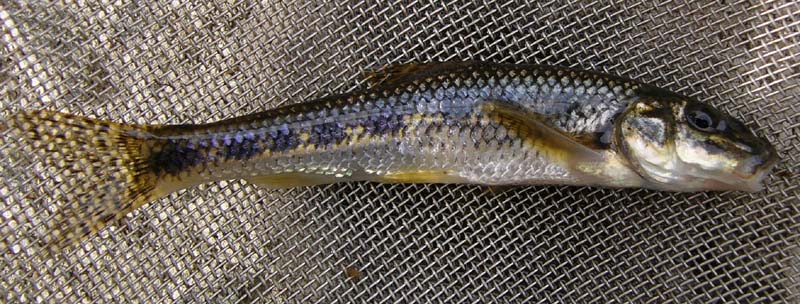
The gudgeon has a characteristically elongated, slender, rounded (nearly cylindrical) body, very little laterally compressed — a perfect body for bottom life. The head is broad and flattened, adapted for benthic life. The snout is relatively blunt. The mouth is inferior, horizontal, perfect for sucking food from the bottom. The most distinctive feature are the barbels: one long barbel at each corner of the mouth, rich in sensory receptors for detecting food in sand.
Coloration is discreet, perfectly camouflaged for life on sandy bottoms: pale yellowish-grey or brownish-grey back, lighter flanks with 7-9 large blackish spots arranged in a row along the body (characteristic and diagnostic), yellowish-white belly. Average dimensions are 8-12 cm and 15-40 grams, rarely over 15 cm.
Habitat and Distribution
The gudgeon is a strictly benthic fish specialized for sandy and stony substrates — one of the few species that absolutely requires clean sand or gravel, completely avoiding muddy bottoms. In the Danube Delta, the gudgeon is present but localized, occupying exclusively zones with hard clean substrate: the main Danube arms with fine sand or gravel, maritime canals with clean sandy substrates, stony-sandy confluence zones.
Ideal habitat includes exclusively sandy, stony, or gravel substrates (completely avoids mud), clear or moderately turbid water, weak to moderate current, well-oxygenated water, and open clean bottom surfaces without excessive vegetation. The gudgeon is extremely gregarious — living in large schools of several hundred individuals that move together over sandy bottoms. It is sensitive to pollution and requires good water quality maintenance.
Behaviour and Diet
The gudgeon is a benthic omnivore specialized in feeding on sandy bottoms. Diet includes: aquatic insect larvae (ephemeroptera, chironomidae, small trichoptera), oligochaete worms, small crustaceans, small molluscs, diatoms, organic detritus from sand, and occasionally fish eggs and fry. Feeding mode is characteristically benthic: the gudgeon uses its sensory barbels to detect food in sand, then sucks up particles of sand and sediment with its inferior mouth, selects edible particles and expels the rest.
A fascinating and unique characteristic is the ability to emit squeaking sounds, considered a means of communication between individuals in the school — gudgeon "talk" to each other, probably to maintain school cohesion or signal danger. Gudgeon are preferred prey for many predators: constituting up to 45% of the common otter's diet and 25-45% of the common kingfisher's diet.
Life Cycle and Reproduction
The gudgeon reaches sexual maturity relatively early, at 2-3 years when 6-9 cm. Reproduction occurs in spring and summer, between April and August (a long, extensive period), when water temperature exceeds 13°C. During the spawning period, gudgeon undertake short migrations from deeper zones toward very shallow surface waters in well-oxygenated areas with moderate current and clean gravel or pebble substrates.
Fecundity is moderate: a female deposits a few thousand eggs per season (estimated 3,000-8,000, depending on size). Eggs are small, translucent, adhesive with special adhesive filaments that anchor them to stones or other substrate elements until hatching. Hatching occurs after approximately 7-10 days. Growth: first year 4-6 cm, second 7-10 cm, third 10-12 cm, then growth slows dramatically. Lifespan is short (5 years typical).
Conservation Status
The gudgeon is classified as "Least Concern" (LC) by IUCN, with a wide distribution across Europe and abundant in many localities. In Romania and the Danube Delta, populations are relatively healthy but limited habitat (requires clean sandy substrates) restricts distribution. It does not benefit from special protection measures. The gudgeon plays an important ecological role as a trophic transfer link: consuming small benthic fauna and serving as crucial prey for apex predators (otter, kingfisher, pike, zander).
Threats are moderate: hydrological changes (river channelization, removal of natural sand, covering substrates with silt), water pollution, eutrophication leading to mud accumulation over natural sandy bottoms, ballast and sand extraction from rivers. In Romania, many Natura 2000 sites have been designated for gudgeon conservation, including in the Danube Delta.
Sources