Physical Characteristics
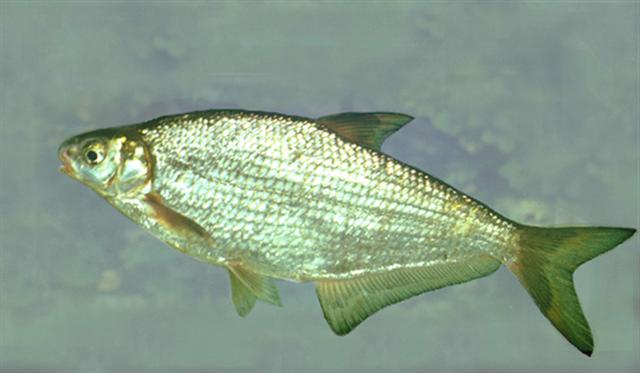
The white-eye bream has an elongated, tall body, strongly compressed laterally, similar to the common bream but smaller and slimmer, with a pronounced arched dorsal profile. The head is small relative to the body. The most distinctive feature giving it its English name is the very large eye, with a diameter approximately equal to the length of the snout (in the common bream the eye is much smaller) - the eyes have a white-silver or bright yellowish iris, very prominent. The snout is short and slightly flattened. The mouth is small, inferior (positioned below the snout), without barbels - an adaptation for benthic feeding.
This small, inferior mouth is the main trait distinguishing the white-eye bream from the related species Ballerus ballerus (blue bream). The body is covered with relatively large cycloid scales, the lateral line having 47-54 scales. Coloration is discrete and elegant: greenish or bluish back with metallic reflections, silver-grey or yellow-silver flanks with pearly sheen, white-silver belly. Average dimensions are 15-25 cm and 150-400 grams, but large specimens can reach 30-35 cm and 600-800 grams.
Habitat & Distribution
The white-eye bream is a benthopelagic fish occupying a very specific and restricted habitat - it exclusively prefers fast-flowing or moderately to strongly current waters in the lower reaches of large rivers and streams, completely avoiding ponds and still waters where the common bream thrives. In the Danube Delta, the white-eye bream is present but rare and localized, occupying mainly the principal Danube arms with moderate current (Chilia arm, Sulina arm in current sections), maritime channels with constant flow, and confluence zones.
It can also penetrate the moderate brackish regions at the Delta mouths, tolerating low salinities. The ideal habitat includes zones with moderate depths (2-6 meters), sandy, stony, or hard muddy bottoms, moderate to strong current, well-oxygenated water. On the Danube, the white-eye bream tends to migrate upstream - historically it ascended to Bavaria on the Danube, demonstrating impressive migratory capacities for a benthic cyprinid. It tolerates temperatures between 0°C and over 25°C, with the optimum being 10-20°C.
Behavior & Feeding
The white-eye bream is a specialized benthic omnivore, spending most of its time on the river bottom searching for food in sediments and among pebbles. The diet is varied and adapts to available resources: benthic invertebrates (chironomid, mayfly, and caddisfly larvae), small crustaceans (gammarids, ostracods), small mollusks (snails, young mussels), oligochaete worms, aquatic plants and benthic algae, organic detritus.
The feeding mode is characteristic of benthic consumers: the white-eye bream uses its small inferior mouth to aspirate sediment and select edible particles, expelling residues through the gills. Feeding activity is intense in the early morning and evening. Social behavior is moderately developed: shoals provide protection against predators and allow efficient exploitation of areas with concentrated food. It is a relatively timid and cautious fish, quickly retreating to deeper areas or into the current when sensing danger.
Life Cycle & Reproduction
The white-eye bream reaches sexual maturity relatively late for a cyprinid of moderate size, at 3-4 years when it is 12-18 cm long, making it more vulnerable to overfishing than species that mature quickly. Reproduction takes place in spring, between April and May, when water temperature reaches and exceeds 8°C (optimum 10-15°C). The white-eye bream undertakes upstream migrations on rivers towards spawning grounds, seeking fast-flowing, well-oxygenated waters with gravel, coarse sand, or submerged vegetation bottoms.
Fecundity is moderate: a female lays between 10,000-40,000 eggs depending on size. The eggs are relatively small (1-1.5 mm diameter), sticky, and adhere to stony substrate or submerged vegetation in areas with fast current. Hatching occurs after 8-15 days depending on temperature. Growth is relatively slow: in the first year the white-eye bream reaches 5-8 cm, in the second 10-15 cm, in the third 15-20 cm.
Conservation Status
The white-eye bream is classified as "Least Concern" (LC) by IUCN globally, with a wide distribution in the Ponto-Aralo-Caspian basins, but populations are in moderate decline in many regions due to hydrological modifications and pollution. In Romania, the species is quite rare and localized, with healthy but numerically reduced populations in the lower Danube and delta. It does not benefit from special protection measures - there is no minimum legal retention size or specific prohibition periods, but it is covered by the general spring reproduction prohibition (April-May).
Main threats include: hydrological modifications (dams disrupting migrations, river channelization eliminating fast-current habitats), water pollution, eutrophication, and accidental fishing. Loss of spawning habitats with fast current and natural bottoms is probably the most serious long-term threat. Sustainable management in Romania requires maintaining water quality, protecting zones with natural current and uncemented bottoms, and preventing construction of additional dams.
Sources