Physical Characteristics
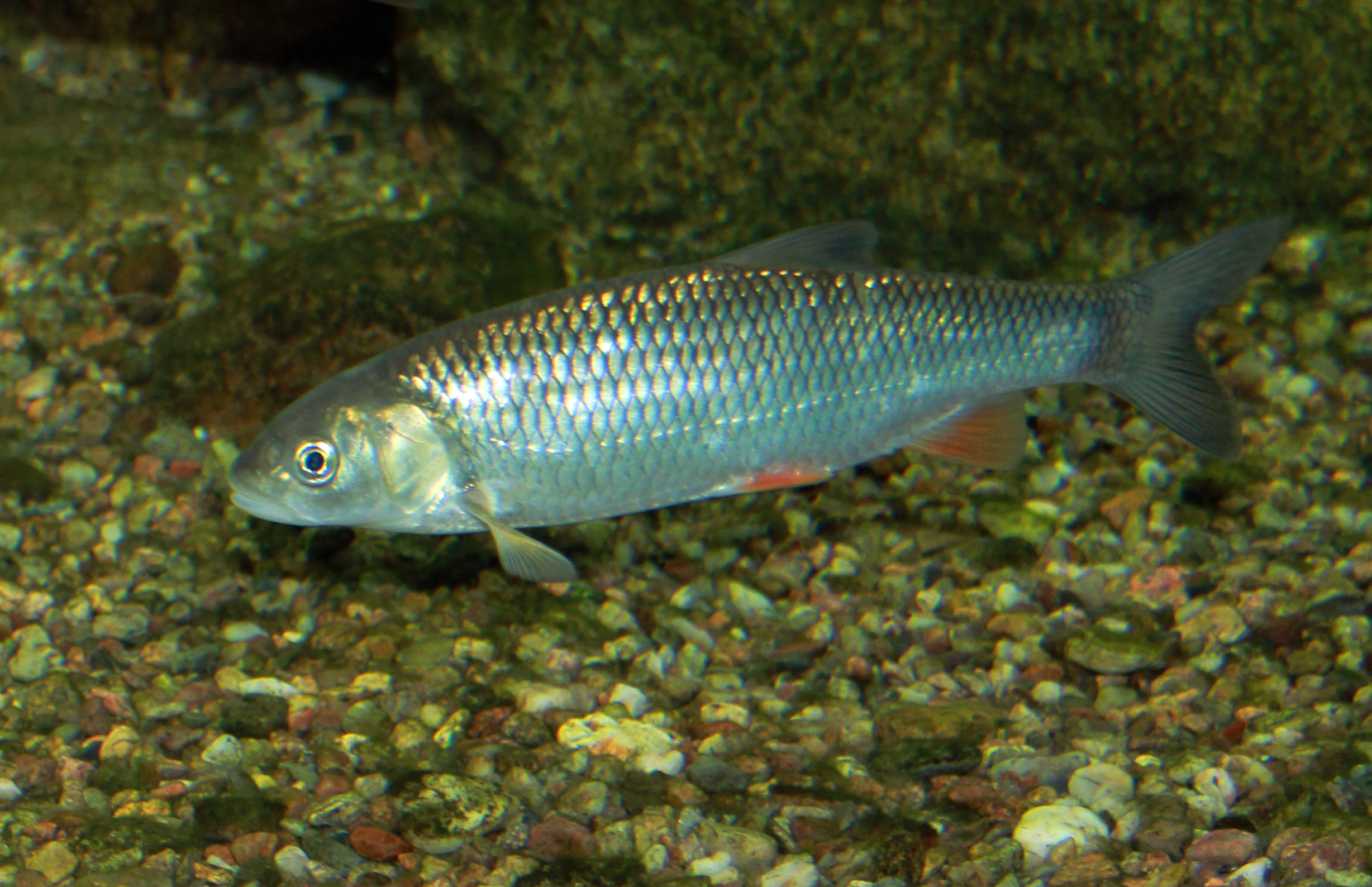
The European chub has a robust, stocky, elongated, and cylindrical body (not laterally compressed like most cyprinids), giving it a characteristic "torpedo" silhouette. The most distinctive feature is the large, broad, and rounded head — one of the largest heads relative to body size among cyprinids. The mouth is large, terminal, with very thick, fleshy, and prominent lips — an adaptation for diversified feeding both on the bottom and at the surface. It has no barbels. Eyes are relatively small, yellowish or orange.
The body is covered with large, thick, well-attached scales of green-brown or olive-green color with narrow distinctive black margins. Coloration: dark green-brown or olive-green back with bronze reflections, silver-golden flanks with metallic sheen, yellowish-white belly. All other fins (pectoral, ventral, anal) are characteristically orange-red or bright red — an important distinguishing feature. Average dimensions are 30-40 cm and 800 grams to 1.5 kg, but mature specimens frequently reach 50 cm and 2-3 kg.
Habitat and Distribution
The European chub has extraordinary ecological adaptability, present from fast mountain streams to calm lowland lakes and even brackish zones. In the Danube Delta, the chub is present but localized, preferentially occupying the main Danube branches with constant moderate current (especially the Chilia arm), maritime canals with constant flow, confluence zones between large canals and lakes, and occasionally in large lakes well-connected to the Danube.
The ideal habitat includes varied depths (0.5-4 meters), preferably hard substrates (gravel, stony, sandy), moderate current or moving water, clear or moderately turbid well-oxygenated water, presence of structures and riparian vegetation. The chub is extremely versatile in water column use — constantly moving between bottom, middle, and surface depending on food availability.
Behaviour and Diet
The chub is an extremely opportunistic omnivore — probably the least choosy cyprinid in Romanian waters regarding diet. It consumes practically anything: benthic invertebrates (insect larvae, crustaceans, molluscs), terrestrial insects falling on water, small fish (it is partially cannibalistic), amphibians, fruits and seeds falling from trees (blackberries, elderberries, cherries), plant material, and even occasionally water voles or young waterfowl.
Chub over 15 cm often adopt a predominantly piscivorous diet. Feeding mode reflects versatility: it feeds on the bottom, mid-water intercepting drifting prey, at the surface leaping after insects (often spectacular, creating loud splashing), and under riparian vegetation awaiting falling fruits and insects. Feeding activity is intense in early morning, evening, and at night. Small specimens are gregarious and bite freely, but large chub become extremely cautious and sensitive to noise and vibrations.
Life Cycle and Reproduction
The chub reaches sexual maturity at 2-4 years for males (15-25 cm) and 4-6 years for females (20-30 cm). Reproduction occurs in spring and summer, between May and September (one of the longest spawning periods), when water temperature reaches 14-15°C. The chub undertakes spawning migrations: those from lakes move up into tributary streams; those from large rivers seek fast-current zones.
Females spawn in multiple portions (2-3 times per season) with 2-3 week pauses. Fecundity varies with size: 50,000-200,000 eggs per season. Eggs are small, pale yellowish, adhesive, and attach to gravel, stones, and vegetation. Growth: first year 8-12 cm, second 15-20 cm, third 22-28 cm, then 3-5 cm/year.
Conservation Status
The European chub is classified as "Least Concern" (LC) by IUCN, with an extremely wide distribution across Europe and Western Asia. In the Danube Delta, populations are healthy but not extremely numerous due to limited habitat. It does not benefit from special protection measures — there is no minimum legal retention size or specific closed seasons.
The chub plays an important ecological role as a mid-level generalist predator. Threats are minimal due to extraordinary adaptability — it withstands moderate pollution, tolerates habitat modification, and thrives even in artificial canals and degraded waters. The main potential threats include severe chemical pollution and dams blocking spawning migrations.
Sources